
Winter Newsletter 2025

‘Tis the season for Colitis
What is colitis?
Colitis is the inflammation of the large intestine (colon and caecum).
What causes colitis?
Colitis can have many causes, both infectious and non infectious. Infectious causes include Salmonella, coronavirus and parasites such as redworms. Non infectious causes include diarrhoea induced by antibiotics, sudden changes in management or feed, internal pathology (e.g. a tumour), inflammatory bowel disease, eating poisonous plants and the use of non steroidal anti inflammatory drugs such as bute or flunixin.
What are the symptoms of colitis?
Colitis can present in a number of different ways, the most common clinical sign associated with colitis is diarrhoea, however this is not always present and other signs of abdominal discomfort (colic) including rolling, flank watching and lying down may be present. Horses with colitis often have a high temperature and show signs of dehydration which include tacky mucous membranes, increased skin tent time, cold extremities and a weak pulse. Horses suffering from colitis can begin to lose proteins, which can cause a plaque of oedema (swelling) under their chest and / or abdomen. If left untreated or in severe cases, horses with colitis can begin to show signs of endotoxaemia which includes an increased heart rate or respiratory rate, dark pink mucous membranes and decreased blood flow to body tissues..
How is colitis diagnosed?
If your vet suspects your horse may be affected by colitis, they will take a blood sample for analysis, use an ultrasound scanner to assess the abdomen and take a sample of the peritoneal fluid for analysis..
How is colitis treated?
Treatment for colitis often needs to be aggressive in order to be successful. In most cases, hospitalisation is recommended for intravenous fluid therapy to replace lost electrolytes and for rehydration. Colitis can cause abdominal discomfort and so pain relief in the form of anti inflammatories can be given. If blood results have revealed a particularly low total protein concentration, it may be necessary to give a plasma transfusion. Antibiotics may be necessary in some cases if the cause is thought to be bacterial; also steroid therapy is often essential to reduce inflammation in the colon. In severe cases, colitis can have a systemic inflammatory effect and in these cases there is an increased risk for the development of laminitis. When hospitalised with colitis, all horses are kept in isolation to prevent transmitting any disease from one horse to another, and some causes of colitis can even be transmitted to humans. Vital parameters are monitored closely with blood samples taken repeatedly to assess progression and effectiveness of treatment.
How can I prevent colitis?
Prevention is always better than cure and there are a number of ways you can reduce the risk of colitis occurring on your yard:
• Ensure good biosecurity with equipment being cleaned each day.
• Isolate any horses showing signs of sickness or diarrhoea
• Consult your vet about an appropriate worming regime for your horse including regular faecal worm egg counts.
• Use antibiotics responsibly and never without the specific direction of your vet.
• Use anti inflammatory medications such as bute with caution.
• Regularly take your horse’s temperature
When should I call the vet?
Call your vet as soon as your horse shows signs of colic, diarrhoea or a high temperature. Early diagnosis and treatment gives the best chance of success.
In the bleak midwinter...

Frosty grass
If your horse is stabled overnight, it is important to remember that when turning out onto frosty grass can pose an increased risk of laminitis. This is due to the increased sugar content in frosty grass. Ingesting this grass can cause an increase in blood sugar or insulin levels which is particularly dangerous for horses who already suffer from or are at risk of laminitis.
There are several steps which can be taken to reduce the risk factors:
• Delay turning horses out until the temperature is 5C or the frost has fully thawed
• Provide alternative forages in the paddock such as hay or haylage.
To rug or not to rug?
With all the rugs available and the endless information (and misinformation) online, it is difficult to know which rug and which weight to choose. Horses have a much lower thermoneutral zone (the temperature range in which no energy is expended to keep warm) than humans. A horses thermoneutral zone is between 5-25C compared to to a humans which is 20-35C. This means that a horse which is not clipped doesn’t need additional help to keep warm until temperatures drop below 5C.
You can check how warm your horse is feeling by checking extremities such as ears and if these are cold they may need a rug on. Don’t forget that clipping and illness will make horses feel colder and these horses will need additional help to stay warm.
* Thinking ahead to sunnier times *
It is never too early to begin planing for next season, and our vets can help make sure your horse
is fit and ready to go!
Annual Healthcare Package
In order to provide routine care for your horse, we are able to offer an annual healthcare package which includes:
• General health examination Annual vaccination
• Routine dental rasping
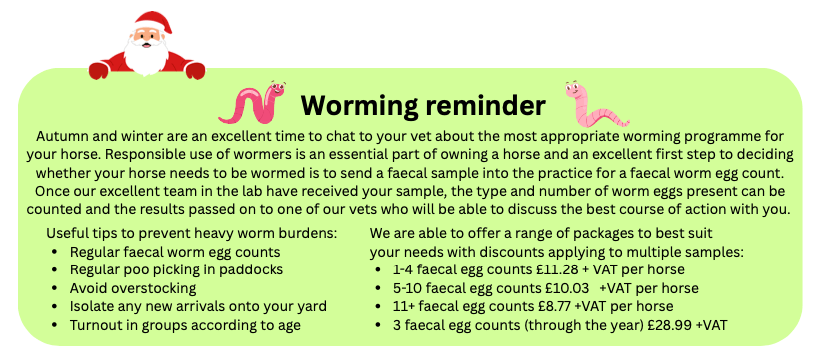
• Two faecal worm egg counts
This is available for £147.79 + VAT plus a usual visit fee. Additionally we are able to offer a full blood profile for an extra £88.75 + VAT.
Pre season checklist
To ensure you and your horse can get the most out of the spring and summer ahead we have created a pre season checklist:
• Vaccinations - within 6 months and 21 days for FEI horses or no later than 1 year for boosters
• Dental check - ensuring your horse is comfortable in its mouth will mean better ridden work
• Faecal egg counts - ensure your horse is feeling good from the inside out
• Lameness assessment - make sure your horse is moving well and doesn’t have any little niggles which may cause discomfort.
Happy Christmas from us all!


TCEH is also on Facebook
We would love to hear your comments and feedback, as well as providing regular updates on current topics and case stories.